A focus on dense, walkable development allows cities to pack more
economic punch per square foot, according to a new study. In Washington
DC, deemed the most walkable U.S. city, the most walkable areas in the
city take up less than one per cent of the total acreage, but represent
almost half of the most wealth-generating square footage for the whole
city.
The study
was authored by the Center for Real Estate and Urban Analysis at George
Washington University School of Business in conjunction with LOCUS:
Responsible Real Estate Developers and Investors. It’s an initiative of
Smart Growth America, which also co-authored a great study on pedestrian safety
earlier this year. They have taken a different path to determine a
metropolitan area’s walkability, which helps to illustrate how, exactly,
a more walkable place is more financially lucrative for a city.
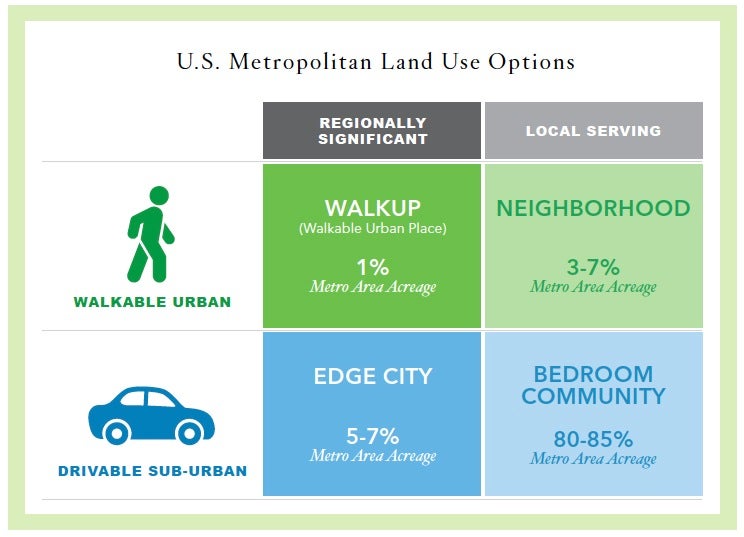
Instead of isolating city vs. suburb, as many studies tend to do,
this study acknowledges that there can be drivable communities in urban
centres and walkable communities in exurbs, but that places with good
walkability share common qualities: high density, a mix of real estate
uses, multiple transportation options, and the ability to serve the
daily needs of residents largely on foot.
To find the most walkable places in the country, rather than looking
simply at a city’s center, the study looked at places where walkability
intersects with regional significance, meaning these are places where
economy-driving development is creating wealth for these areas. They
have used data from several sources including real estate values,
transit information, WalkScore rankings, and census studies to locate
558 “WalkUPs,” or walkable urban places, across the country, and 30
metropolitan areas are ranked by measuring the total number of office
and retail square footage — the capacity for generating wealth — in
those WalkUPs.
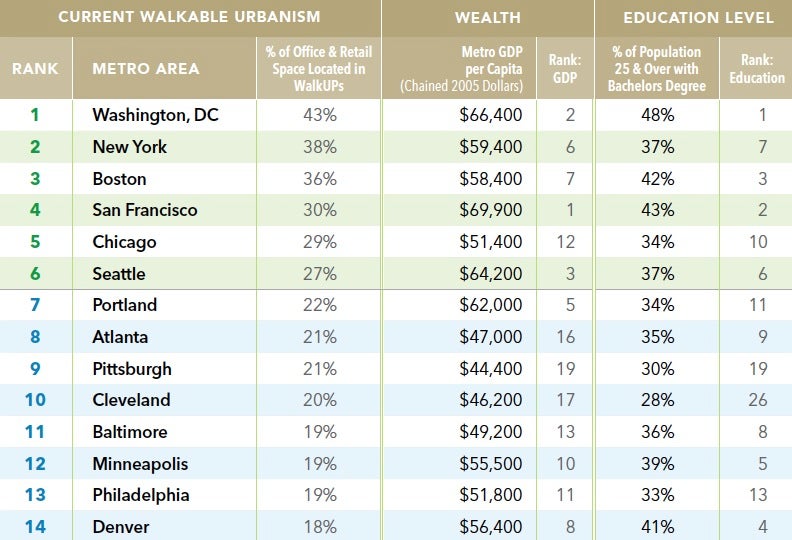
Washington DC ranks first — yes, over New York City — because of its
many walkable centres which are easily connected with transit. Boston,
San Francisco and Chicago round out the top five. The cool thing about
examining walkability within the context of real estate is that the
study can also examine the
potential for walkability, so the
study has also forecast which cities will be more walkable in the
future. (Spoiler: Boston supplants DC as the top city.)
But the most interesting part is seeing how those WalkUP figures
correlate with GDP and education level. In almost every case, a higher
walkability index means more income per capita and higher educational
attainment. The top ranking metropolitan areas have an average of 38 per
cent higher GDP per capita as compared to the low ranking metros, and
74 per cent higher real estate values.
Urbanists have long tried to highlight the correlation between
walkability and economic success as a way to encourage cities to
incentivise denser, more transit-accessible development.
Here it’s clear
that walkable urbanism is a key component to building the places that
people want to live, shop and work — both making and spending their
money. [
Smart Growth America ]


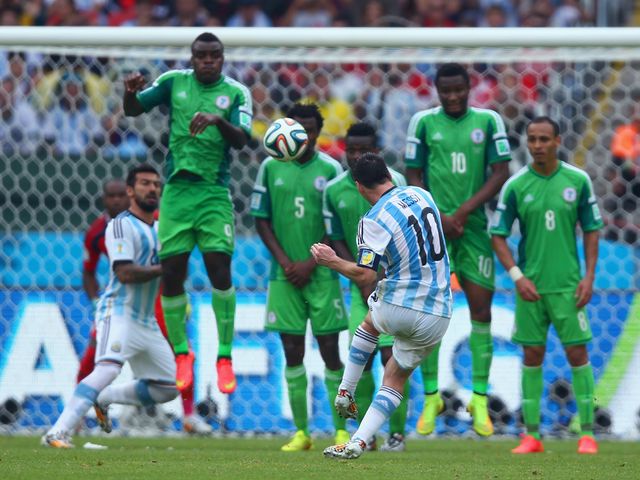 Messi's two goals were twice cancelled out by Nigeria's Ahmed Musa
but Marcos Rojo's second-half finish made sure Argentina took all three
points.
Messi's two goals were twice cancelled out by Nigeria's Ahmed Musa
but Marcos Rojo's second-half finish made sure Argentina took all three
points.